Where Your Phone Sleeps: Rethinking the Nightstand and the Room Beyond It

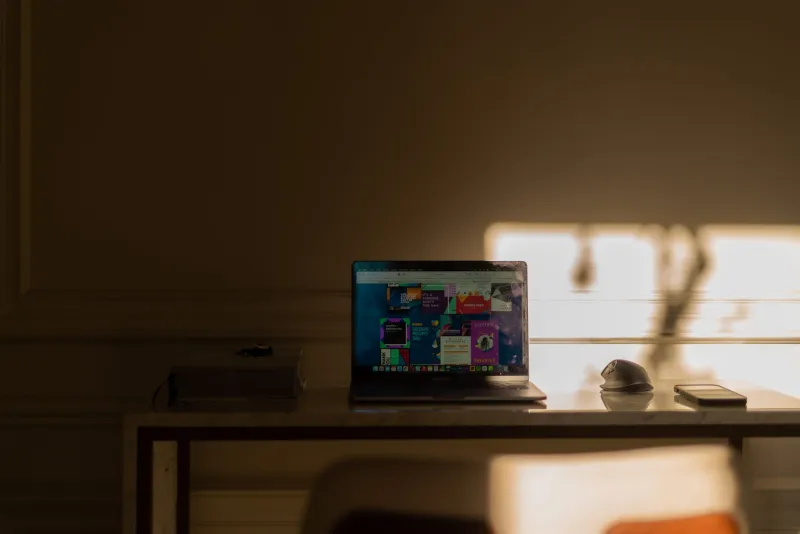
Photo: Pedro Ribeiro Simões from Lisboa, Portugal, CC BY 2.0, via Wikimedia Commons
Walk into your bedroom and look at the surface next to your bed. Whatever is sitting there right now is doing more work than you think. It's the last thing your hand touches at night and the first thing it finds in the morning, and it has been quietly setting the tone of both for years.
Most of us never chose that spot. The phone landed there because the charger was there, or because the outlet was there, or because that's where it went the first night we moved in and it never moved again. It's furniture by accident, not by design.
Time to make it a decision.
The commute your phone makes every night
Think about the path your device travels between 9 p.m. and 7 a.m. For a lot of people it's a two-foot journey: pocket to nightstand, nightstand to hand, hand to face. That's not a commute, it's a handoff.
Now think about what that two feet buys you. The alarm you can't snooze without picking it up. The notification that lights the ceiling at 11:40. The reason your eyes open in the morning and land on email before they land on daylight. Every one of those is a direct result of geography, not weakness of character.
Why location beats willpower every time
Here's the thing about willpower: it's expensive, and it runs out right around the time you're tired. Nine o'clock at night is the single worst moment to ask yourself to make a good decision, because you've been making decisions all day.
Distance is cheaper. If the phone is across the room, checking it becomes a small physical event instead of a reflex. You have to stand up. You have to decide. That half-second of friction is worth more than a dozen productivity apps, because it doesn't ask anything of your depleted brain.
This is why the location matters more than the intention. You're not trying to become a person who doesn't reach for their phone. You're arranging a room where reaching for it takes a little effort.
The nightstand is a bad default
The nightstand evolved to hold a lamp, a book, and a glass of water. Then we handed it a device that contains every distraction humans have ever invented, placed it within arm's reach of a horizontal body, and acted surprised when nobody slept.
Try this test. Put your phone where your nightstand is and ask what else you'd want there. A real alarm clock. A paper book. A glass of water and a lamp that isn't also a screen. None of those things buzz at 2 a.m.
Options that actually work
The hallway shelf. A small shelf or basket just outside the bedroom door. Close enough that you hear a real emergency, far enough that you won't check it out of habit. This is the most popular option for a reason — it isn't exile, it's a boundary.
The kitchen landing zone. A drawer, a bowl, a specific corner of the counter. Works well if your bedroom is small. Pair it with a cheap outlet timer or a charging station away from where you sleep.
The dresser, face down, out of arm's reach. A modest compromise for people who use the phone as an alarm. You'll still get up to silence it, which is arguably the point.
The dedicated drawer. A literal drawer with a literal handle. Something about closing it tells your brain the day is over in a way that a screen never does.
What all four have in common: the phone stays charged, stays reachable in an emergency, and stops being the first and last thing you see.
Don't build a punishment box
There's a temptation to go dramatic — lockbox, timed safe, phone jail. Resist it. Anything that feels like a penalty tends to get abandoned within two weeks, usually on a Tuesday, usually with a slightly guilty feeling attached.
The better principle is this: out of the room, not out of your life. The spot should feel like a place the phone belongs, not a place it's been banished to. A nice bowl by the front door. A shelf with a plant next to it. A charger mounted at standing height by the kitchen counter. Design it the way you'd design a spot for your keys, and you'll actually keep using it.
Also buy a ten-dollar alarm clock. It is the single most effective piece of technology in this entire article.
What the first week actually feels like
Night one, you'll reach for the phone three times before you remember. Night three, you'll notice the room is quieter than usual and it'll be slightly uncomfortable. By night five, you'll probably sleep a little better and won't be able to prove it.
The mornings are the bigger change. Without a screen waiting on the nightstand, there's a strange fifteen seconds where you're just... awake in a bed. Some people hate it at first. Most people, after a week, describe it as the best part.
And if you fail on a Saturday and bring the phone back to bed, that's fine. The shelf doesn't hold a grudge.
A small piece of architecture
You can't redesign the apps. You can redesign the room. Where your phone sleeps is one of the few pieces of your digital life that is entirely, uncomplicatedly yours to decide — no settings menu, no subscription, no terms of service.
Put it somewhere on purpose tonight. Then see what the morning feels like when your first reach is for the day instead of the device.