Designed to Distract: How Apps Are Engineered to Own Your Attention (and How to Take It Back)

Photo: Kristoffer Trolle from Copenhagen, Denmark, CC BY 2.0, via Wikimedia Commons
You've probably had this experience: you pick up your phone to check one thing — a weather forecast, a text message — and emerge fifteen minutes later having watched three videos, scrolled through a feed you don't even care about, and forgotten entirely what you opened the phone for in the first place. You put it down feeling vaguely worse than before.
That wasn't an accident. Not even a little bit.
The platforms you use every day are built by teams of designers, engineers, and behavioral scientists whose explicit job is to capture your attention and hold it as long as possible. The tools they use to do this have a name: dark patterns. And once you learn to see them, you can't unsee them.
What Dark Patterns Actually Are
The term "dark patterns" was coined by UX designer Harry Brignull around 2010 to describe interface design choices that deliberately work against the user's own interests. In the context of attention, dark patterns are the architectural decisions that make it harder to stop using an app than to keep going.
They're not bugs. They're the product.
Some of the most common ones you're already living with:
Infinite scroll removes the natural stopping point that a paginated feed would create. There's no page two to click to — the content just keeps generating, and your thumb keeps moving. The late Aza Raskin, who invented infinite scroll while working at a startup in the 2000s, has publicly estimated that his design is responsible for roughly 200,000 extra hours of scrolling per day across the internet. He's described it as one of his deepest regrets.
Variable reward notifications are modeled directly on slot machine psychology. Not every buzz on your phone carries something meaningful — in fact, most don't. But the unpredictability is the point. Your brain releases a small hit of dopamine in anticipation of what the notification might be, which is often more rewarding than the notification itself. This is the same mechanism that keeps people pulling a lever on a slot machine even when they're losing money.
Phantom vibrations are a documented neurological phenomenon where people feel their phone buzz when it hasn't. Research published in journals including Computers in Human Behavior has found that heavy smartphone users experience these phantom sensations regularly. The design that creates this isn't accidental — it's the result of conditioning your nervous system to be in a constant state of alert for your device.
Artificially urgent notifications use language engineered to trigger FOMO. "People are looking at your profile." "You have 3 unread messages from people you might know." "Your post is getting attention — see how it's doing!" None of these require immediate action. All of them are designed to feel like they do.
What's Happening in Your Brain
The neuroscience here is both fascinating and a little alarming. Attention is not an infinite resource. Cognitive scientists describe it as operating within a limited capacity system — your brain can only hold so much in focus at one time, and switching between tasks or stimuli carries a real cost called "attentional residue."
Every time you're pulled out of a focused state by a notification — even one you dismiss immediately — your brain doesn't snap back to full focus. There's a lag. Studies out of UC Irvine have found that after an interruption, it takes an average of 23 minutes to return to a task at the same level of focus. If you're being interrupted multiple times an hour, you're essentially never reaching deep focus at all.
This is the attention tax. It's levied in seconds and minutes, but the compound interest is paid in cognitive capacity, presence, and the quiet sense that you can't quite think clearly anymore.
Social validation loops amplify this further. Platforms that use likes, hearts, and reaction counts are triggering the same social reward systems your brain evolved to track belonging and status within a tribe. Checking whether your post got a response isn't a trivial action — it's activating ancient circuitry that your brain treats as genuinely important. Platforms know this. They've studied it in detail.
Taking Your Attention Back (Without Going Off the Grid)
The answer isn't to throw your phone in a lake. Technology is genuinely useful, and the goal of mindful tech use isn't abstinence — it's intention. Here's how to start building a relationship with your devices where you're the one making the choices.
Audit your notifications ruthlessly. Go into your phone's settings right now and turn off every non-essential notification. Text messages and calls from real humans: keep. Everything else — social media, news apps, email, games — turn off by default. You can always check those apps when you choose to. The key word is choose.
Introduce friction where you need it. One of the most effective tricks is to log out of social media apps after each use, so you have to actively log back in to open them. This adds just enough friction to interrupt the unconscious habit loop. A few seconds of deliberate action is often enough to make you realize you didn't actually want to open the app in the first place.
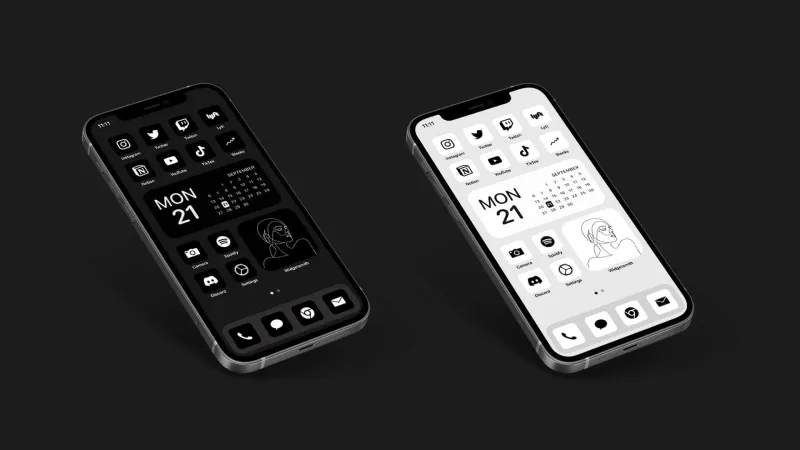
Use grayscale mode. This sounds almost too simple, but switching your phone display to grayscale removes the color cues that make apps visually stimulating. Bright reds on notification badges, the saturated blues and greens of app icons — these are attention-grabbing by design. A gray screen is a boring screen, and boring screens get put down faster.
Designate phone-free zones and times. The bedroom is the most important one. The presence of a phone on your nightstand — even face down, even silenced — has been shown in research to affect sleep quality and morning mood. The bedroom is for rest. Let it be that.
Replace the scroll with something intentional. When you feel the pull toward mindless browsing, have a specific alternative ready. A book on your nightstand. A playlist you actually want to listen to. A five-minute walk. The goal isn't to white-knuckle through the urge — it's to redirect toward something you've already decided matters to you.
Presence Is the Point
Here's the thing about dark patterns: they work because they're exploiting something real. The desire to connect, to be informed, to not miss out on something important — these are legitimate human needs. The platforms didn't invent them. They just found a way to monetize them at the expense of your ability to be present in your own life.
Reclaiming your attention isn't about optimizing your productivity or hitting some metric of screen time. It's about being where you actually are — in a conversation, at a meal, on a walk, in a moment of quiet. Those things are harder to access when your nervous system has been trained to expect a buzz every few minutes.
The technology isn't going anywhere. But neither is your capacity to choose how you engage with it. That capacity is worth protecting.
Start small. Turn off one notification category today. Notice what changes.