Muted Isn't Gone: The Secret Life of Apps You Think You've Silenced

There's a particular satisfaction that comes from diving into your notification settings and flipping everything to off. No more badge counts. No more banners sliding down from the top of your screen. You did the thing. You took control. It feels, genuinely, like exhaling.
Except your phone didn't exhale with you.
That stack of apps you silenced? They're still awake. Still reaching out. Still doing their thing in the background, quietly burning through your battery and, in a way that's harder to measure but just as real, your mental bandwidth. The silence you engineered is a lot more partial than it looks.
What "Silenced" Actually Means to Your Phone
When you mute an app's notifications on iOS or Android, you're telling your device not to show you what's coming in. You're not telling the app to stop checking. Most apps — especially social platforms, messaging tools, and anything with a news feed — are designed with background refresh baked in. They're polling servers, syncing data, and queuing up content whether or not they ever get to announce it to you.
On iPhone, this is called Background App Refresh. On Android, it goes by a few names depending on the manufacturer, but the behavior is the same. The app wakes up on a schedule, does its housekeeping, and goes back to sleep — all without your knowledge or permission. Disabling notifications doesn't touch any of that. Those are two entirely separate systems.
So when you silenced Instagram last Tuesday, Instagram didn't notice. It's still loading your feed in the background, still pulling in Stories, still doing whatever it does. You just stopped getting the tap on the shoulder.
The Battery Math Nobody Talks About
Background activity is one of the more underappreciated battery drains on a modern smartphone. Apple and Google both publish data showing that social apps, streaming services, and email clients running in the background can account for a meaningful chunk of your daily battery consumption — sometimes more than the apps you're actively using.
Here's the thing about silencing versus deleting: deletion is clean. The app is gone. The background process is gone. The server connections are gone. Silencing is more like asking a houseguest to keep it down — they're still there, still eating your food, still using your Wi-Fi.
If you've ever wondered why your phone hits 20% battery by 3pm even though you barely touched it, background app activity from your graveyard of muted apps is a serious suspect.
The Psychological Equivalent of Background Refresh
Here's where it gets more interesting, and more relevant to why we care about this stuff at XZen.
Your brain runs its own version of background refresh. Even when you've muted an app, you still know it's there. You know messages are piling up in that thread you silenced. You know the notifications are accumulating even if they're not lighting up your lock screen. And that knowledge — that low-level awareness — carries a cognitive cost.
Researchers have a name for this: attentional residue. When part of your mind knows there's unfinished business somewhere, even somewhere you've deliberately deprioritized, it keeps a thread open. It doesn't fully let go. The result is a kind of ambient mental noise that doesn't announce itself loudly but makes focused, present-moment thinking harder.
Silencing an app removes the interruption. It doesn't remove the awareness. And for a lot of us, the awareness is actually the bigger problem.
The Illusion of the Clean Dashboard
We're drawn to the idea of the clean phone — no red badges, no banners, no sounds. It looks like peace. It photographs like peace. But if the apps are still there, still running, still accumulating content you're nominally ignoring, you haven't created space. You've just redecorated.
This is the notification graveyard problem. You've buried the alerts, but the apps are undead. They're still moving around in the background, and on some level, you know it.
The zen principle worth borrowing here is the idea of mushin — a mind not occupied by extraneous thought. A mind that isn't quietly cataloging all the things it's chosen not to look at. You can't get there by muting. Muting is a bandage. The real work is subtraction.
What Actually Moves the Needle
If you want genuine quiet — the kind that shows up in your battery stats and your nervous system — here are the moves that actually matter:
Delete, don't mute. If an app has been silenced for more than two weeks and you haven't missed it, that's data. The app isn't serving you. Removing it entirely stops the background drain and removes it from your mental inventory.
Audit Background App Refresh. On iPhone, go to Settings → General → Background App Refresh and turn it off for apps that don't need real-time updates. On Android, look under Battery → Background Usage Limits or App Battery Usage depending on your device. This is the setting that actually stops the background activity, regardless of what you've done with notifications.
Separate "muted for now" from "muted forever." There's a legitimate use case for temporary silencing — you're in a meeting, you're on a camping trip, you're trying to focus for a few hours. That's different from apps you've quietly given up on but haven't had the energy to delete. Know which category each silenced app falls into.
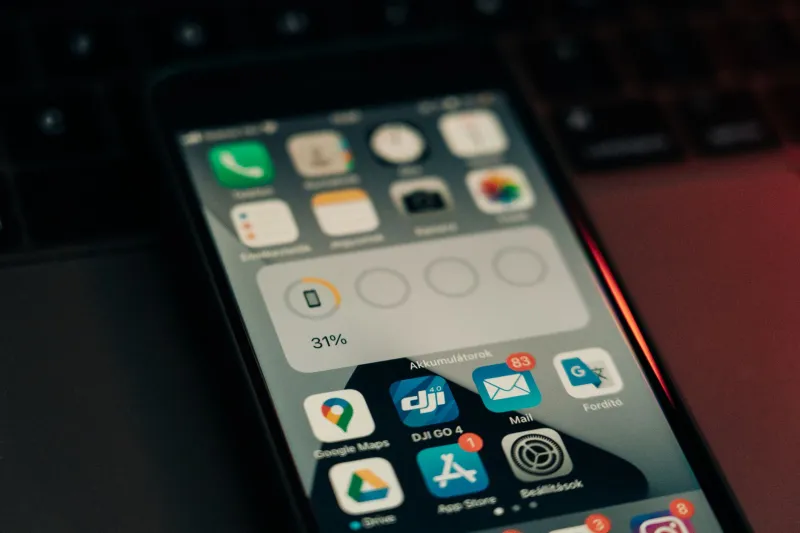
Do a badge audit once a month. Re-enable notification badges temporarily and see what's stacked up. If an app has 200+ unread notifications and your honest reaction is indifference, that app doesn't belong on your phone.
Silence as a Starting Point, Not a Destination
Muting notifications is a reasonable first step. It's better than leaving everything on. But it's easy to treat it as the whole journey when it's really just the trailhead.
Real digital calm — the kind that actually registers in your body and shows up in your ability to think clearly — comes from a phone that reflects your actual priorities. Not a phone where half the apps are technically silenced but still very much present, still consuming resources, still occupying a corner of your attention.
The goal isn't a quieter phone. It's a smaller one. Fewer apps, fewer background processes, fewer open loops. That's the version of silence that actually sticks.